THE ARTIST INTERVIEW · BEOM JUN
Painting What Cannot Be Seen
Beom Jun paints mountains that are not quite mountains: layered, wiped away and painted again, until a ridge becomes a river, the sea, and finally the universe.
Interview and photography by Art & Opus · 10 min read · 4 min film

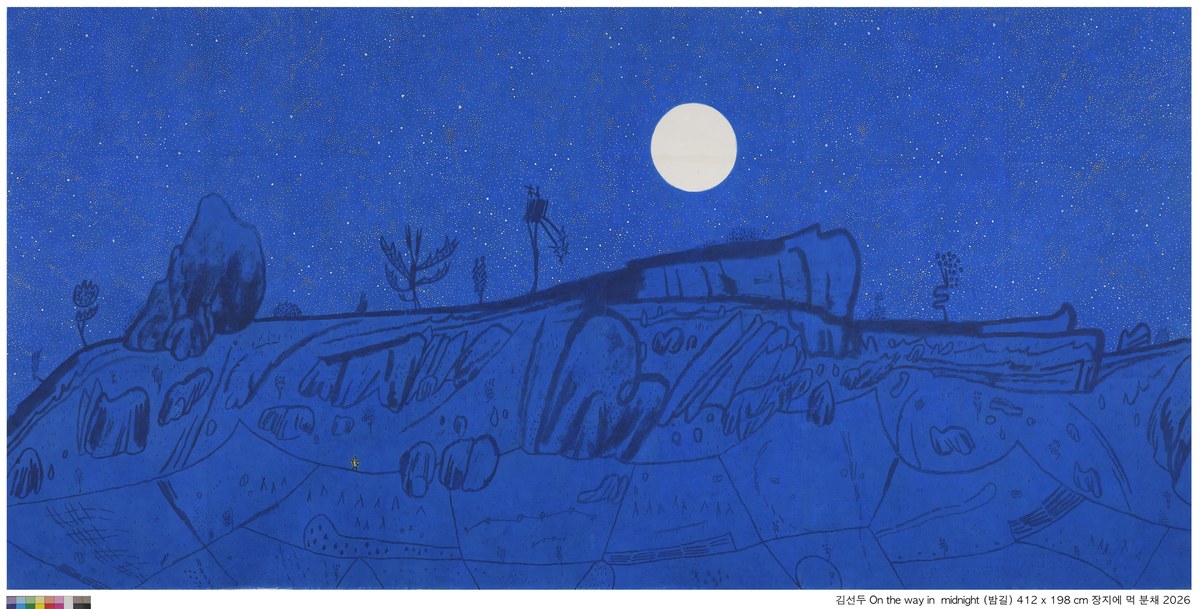
When encountering Beom Jun’s paintings for the first time, viewers naturally think of mountains. Blurred forms unfold in layers across fields of blue, with distant peaks and nearer ridges coexisting within a single frame. Yet the longer one looks, the clearer it becomes that these mountains are not representations of any specific place or landscape.
Layered Mountains: Another Way of Seeing Existence
“People often say I paint mountains. But the mountain isn’t really the subject—it’s closer to a medium.”
For Beom Jun, the mountain is not an object used to describe nature, but a device for revealing how we perceive the world. His work begins not with the question of what to paint, but what are we actually seeing. Traveling back and forth between Jeonju and Seoul, the scenery viewed from the highway became a catalyst—mountain ranges stacking up beyond open plains.
“I started to wonder whether the mountains in the distance really exist, or if that’s simply how we perceive them.” Mountains hidden behind nearer ones—likely to exist, yet impossible to confirm. Beom Jun began translating this uncertainty into painting. His mountains never appear with clear outlines at the outset. They exist instead in a hazy state, overlapping and unresolved.

A Painterly Language Built from Layers
The core of Beom Jun’s visual language is the layer. Mixing oil paint with medium to achieve translucency, he repeatedly applies and wipes away paint. Rather than completing a surface in a single gesture, he paints, erases, and lets it dry—again and again, sometimes dozens of times.
“I apply transparent paint, let it dry completely, then build up the most distant mountain first. And then I wipe it away again.”
This repetition is not merely a technique; it is the concept. Front and back layers continuously influence one another. No single layer exists independently. This approach resonates with ideas of superposition and indeterminacy from quantum physics, concepts that have long interested him.


Time That Unfolds Like a Practice
Beom Jun’s paintings are never made quickly. A single work often takes two to three months, with layers accumulating thirty times or more. Without waiting for paint to dry, the next step is impossible.
“Waiting is essential. If it doesn’t dry, there is no next stage.”
This slow rhythm connects to his earlier background in performance and video, where endurance and bodily practice were central. While the medium has changed, the passage of body and time remains constant. For him, painting is an extension of practice—almost ascetic in nature.

Mountains That Refuse to Stay Still
As layers accumulate, the mountains gradually begin to resemble something else. Some works appear like fire, others like water, waves, or even cosmic imagery.
“The more I painted, the less it felt like it had to be a mountain. Sometimes it becomes a river, sometimes the sea, sometimes the universe.”
For Beom Jun, the mountain is never a fixed image. It is a constantly shifting state, resistant to definition. This fluidity expands his work from nature to the cosmos, and ultimately back to human existence.
AVAILABLE WORK
1 / 3‹›


Life and Death Are Not Opposites, but a Shared Flow
As his work deepened, his paintings moved beyond spatial layering toward questions of existence itself. Behind this shift lies a period of physical pain the artist experienced firsthand. Through it, he came to see death not as an endpoint, but as part of a continuous cycle.
“Death didn’t feel like the opposite of life, but something contained within the same flow.”
From this realization, the “infinite” in his work becomes tangible rather than abstract: time spent enduring pain, waiting for recovery, standing still amid uncertainty. These lived durations pass directly into the layers of the canvas. That is why his paintings feel both cosmic and deeply human.
From a Finite Surface Toward the Infinite
Through mountains, Beom Jun establishes boundaries on the canvas. Yet these boundaries never stay fixed. As layers continue to accumulate, the surface fills—and paradoxically begins to feel empty again. “It feels completely full, and then suddenly it feels infinite.” What Beom Jun calls the “universe of the mind” emerges precisely here.

A Canvas Open to the Viewer
Beom Jun does not prescribe interpretations. His paintings insist on neither a specific place nor a single meaning. Viewers enter the work carrying their own memories and experiences.
“I hope people recall their own experiences while looking—maybe a happy moment, maybe something entirely different.”
For this reason, his paintings remain open. Layered mountains transform into entirely different landscapes depending on who is looking. Like mountains that appear, fade, and reemerge through layers, Beom Jun’s work remains ongoing, not moving toward an end, but toward ever-widening questions.